

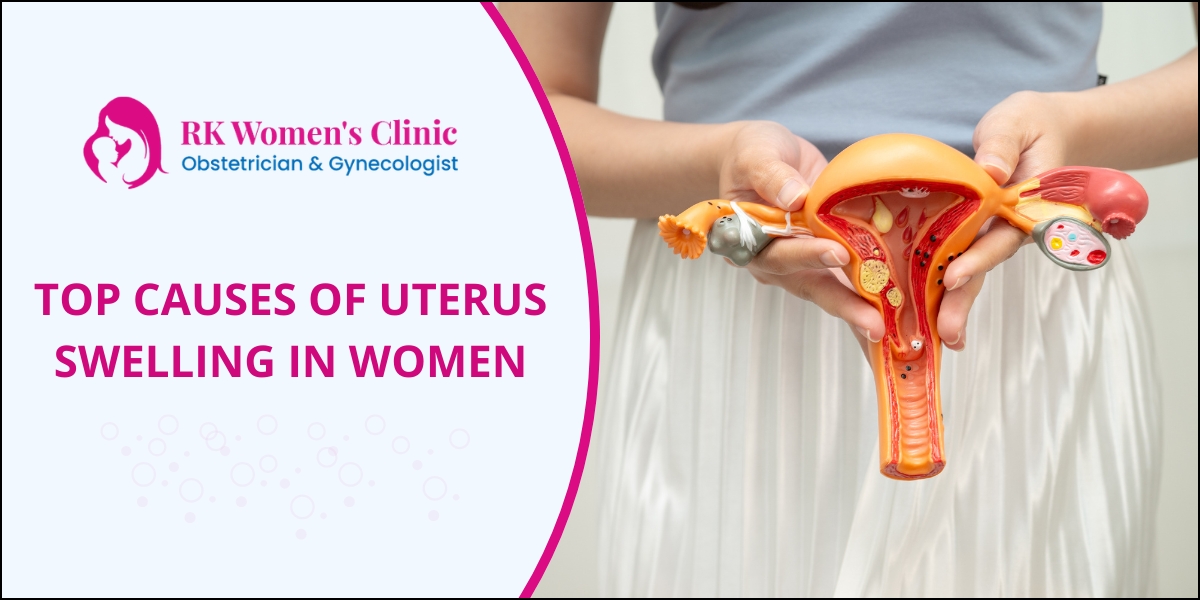
Have you been feeling a persistent heaviness in your lower belly? Or maybe you’ve noticed your clothes feeling tighter around the waist, or your periods have become unusually heavy. You might be experiencing symptoms related to uterus swelling, medically known as an enlarged uterus.
First, don’t panic. An enlarged uterus is a common condition, and in most cases, it is caused by non-cancerous issues that are very treatable . Understanding what is happening inside your body is the first step toward feeling better.
The uterus (or womb) is usually about the size of a fist or a small pear . It’s a powerful muscle designed to hold a growing baby. But sometimes, due to various reasons, it can swell up to the size of a grapefruit or even larger . This can lead to discomfort and other symptoms.
Let’s break down the most common causes of uterus swelling in simple terms.
1. Uterine Fibroids: The Usual Suspect
The most common reason for a swollen uterus is fibroids . Think of fibroids as non-cancerous growths or lumps that develop in the wall of the uterus. They are not tumors, and they very rarely turn into cancer .
- What happens? Fibroids can grow as a single lump or in clusters. Depending on their size and location, they simply take up space, stretching the uterus and making it bigger .
- Who gets them? They are incredibly common. In fact, studies show that up to 75% of women may have them by the time they reach 50 .
- Symptoms: Many women with fibroids don’t even know they have them! For others, it can cause heavy, painful periods and a feeling of pressure in the tummy .
2. Adenomyosis: When the Lining Grows Inward
This condition has a complicated name, but the idea is simple. Your uterus has a lining that thickens and sheds during your period (that’s the bleeding). In adenomyosis, this lining grows into the muscular wall of the uterus .
- What happens? Imagine the inner lining digging into the thick muscle. Every time you have a period, this tissue inside the muscle bleeds, causing the uterus to become inflamed, painful, and enlarged .
- Symptoms: This often leads to very painful periods and heavy bleeding. It is most common in women who have had children, usually between the ages of 40 and 50 .
3. Endometriosis
You’ve probably heard of this one. Endometriosis is similar to adenomyosis, but instead of growing into the uterine muscle, the lining-like tissue grows outside the uterus on other organs like the ovaries or fallopian tubes .
- What happens? This wayward tissue also responds to your monthly cycle, bleeding and causing inflammation. While the uterus itself isn’t always the source of the growth, the widespread inflammation and scarring can sometimes affect the uterus and cause it to feel swollen or tender.
4. Hormonal Imbalances
Our hormones, especially estrogen, act as a growth signal for the uterus . Sometimes, due to stress, age (like during perimenopause), or other health issues, your estrogen levels may stay higher than they should without enough progesterone to balance it.
- What happens? This “unopposed” estrogen can cause the uterine lining (the endometrium) to grow too thick—a condition called endometrial hyperplasia . A thicker lining naturally makes the uterus bigger.
- Warning: If left untreated, this thickening can sometimes lead to uterine cancer, so it’s important to get it checked .
5. Pregnancy
This is the most natural cause of a swollen uterus! As a baby grows, the uterus expands dramatically to accommodate them. It’s a healthy and normal part of pregnancy. However, it is still technically “enlargement,” which is why it’s always on the list of causes .
6. Pelvic Inflammatory Disease (PID)
PID is an infection of the female reproductive organs, often caused by sexually transmitted bacteria . If the infection spreads to the uterus, it can cause swelling and inflammation.
- What happens? This is your body’s immune response fighting the infection, which leads to the uterus becoming tender and enlarged.
When to See a Doctor
It is always better to be safe than sorry. You should consult a doctor if you experience:
- Heavy bleeding that disrupts your life.
- Severe cramping or pelvic pain.
- A feeling of fullness or pressure in your lower belly.
- Pain during sex.
- Frequent urination (caused by the uterus pressing on your bladder) .
Getting a proper diagnosis is usually simple. Doctors often use a pelvic exam or an ultrasound—a painless scan that shows a picture of your uterus—to figure out exactly what’s going on .
Taking charge of your health starts with understanding your body. If something feels off, listen to it. With the right information and the right doctor, you can find relief and stay healthy.
Visit Dr. Akula Ramya Krishna – Best Gynecologist in Thane West
If you are looking for expert and compassionate care for uterine health or any gynecological concerns, consult the best in the field. Dr. Akula Ramya Krishna stands out as a leading Obstetrician and Gynecologist in Thane West. With over 10 years of experience and advanced qualifications (MBBS, DNB in Obstetrics & Gynaecology), Dr. Akula Ramya Krishna is dedicated to providing personalized treatment plans for conditions like uterine fibroids, endometriosis, and heavy bleeding.
Frequently Asked Questions
1. What are the first signs of an enlarged uterus?
The first signs often include heavy or prolonged menstrual bleeding, pelvic pain or cramping, a feeling of pressure or fullness in the lower belly, frequent urination, and sometimes lower back pain or bloating .
2. Can an enlarged uterus be cured without surgery?
Yes, absolutely. Treatment depends on the cause. Many cases are managed with medications like hormonal birth control to regulate bleeding, pain relievers, or lifestyle changes. Minimally invasive procedures like uterine artery embolization are also options before considering surgery .
3. Is an enlarged uterus a sign of cancer?
In the vast majority of cases, no. Most swelling is caused by benign conditions like fibroids or adenomyosis . However, in rare cases, uterine or endometrial cancer can cause enlargement. This is why it is crucial to see a doctor for a proper diagnosis to rule out any serious issues .
4. Does an enlarged uterus affect fertility?
It can, depending on the cause. For example, large fibroids (especially submucosal fibroids inside the uterine cavity) or severe adenomyosis can interfere with implantation or pregnancy. However, many women with an enlarged uterus conceive and have healthy pregnancies with proper medical management .
5. How is an enlarged uterus diagnosed?
Doctors typically diagnose it first through a routine pelvic exam where they can feel the size and shape of the uterus. The most common way to confirm and find the cause is with an ultrasound, which provides images of the uterus and surrounding structures .